Search This Blog

Monday, May 13, 2013

Review: Day into Night By Dave Hugelschaffer


Day into Night 
By Dave Hugelschaffer


Opening sentence:  By the time I arrive, the fire has grown to an area the size of a small city.

From this alarming opening, and in breath-stealing smoke and ash that quickly feels all too real, we follow forest fire investigator Porter Cassel through his preliminary search for a point of origin. The fire is an arson, one of a string started in similar fashion by someone who knows just how to take advantage of natural fluctuations in wind and humidity, and the crews all know they are in for a long battle.

For Porter, the battle quickly becomes personal. Not only do the arsonist’s signature materials match those of the eco-terrorist known as the Lorax, but the fire boss is none other than the father of Porter’s girlfriend, who died in a previous Lorax-engineered explosion. As the smoke streamers turn black, blocking out the sun, Porter searches among the locals, the tree huggers, and the fire crews for any possible leads to the identity of the Lorax.

With one fire under control, the long, hot summer looms ahead, providing endless opportunities for another big blaze. Suspects are many, and another explosion costs another life. Porter spends too many hours in his truck, too many more in meetings of an inter-agency task force, and runs afoul of more than one disgruntled citizen in his determination to solve the explosions and resolve his guilt over his girlfriend’s death.

The author spent ten years working for the Forest Service in Northern Alberta as a Ranger, a timber cruiser, and a firefighter. He knows his terrain, tools and crews, and the behavior of a forest fire, better than anyone writing mysteries in Canada today. “Day Into Night” is both a primer on forest fires and a gripping personal quest for truth.


Day Into Night


Published by CormorantBooks

Review: "Hard Currency" by Steven Owad


Hard Currency 

by Steven Owad


Opening sentence: Between the train station and the shoe factory stood reminders of why Julian had brought Krystyna here: a butcher shop without meat; a line of people outside a bakery that wouldn’t open for an hour; bottles in gutters; listless men lolling on park benches, the morning hours grinding by in slow motion.

This is the ‘before’ of Poland – in 1983, still in the grip of Communism – a brief, evocative scene establishing both the repressive political climate and Julian Krol’s love for his little sister. A few pages and nine years later, Poland is celebrating its post-Solidarnos economic and political freedom, and Julian has lost touch with Krystyna. When told she is dead, an apparent suicide, he cannot reconcile what he hears about her tawdry life in prostitution with the intelligent, ambitious girl she had been. Setting out to learn how she came to that end, he stirs up an unexpected hornet’s nest of political corruption and economic game-playing that threatens him and everyone he comes in contact with.

Julian draws on his journalistic resources to trace a translation job Krystyna was doing on the side, one that required her knowledge of languages and dialects stretching all the way to Pakistan. His determination to discover who was behind that job attracts the attention of both the official police and ugly enforcers from several criminal classes. Interspersed with the present action are Julian’s memories of Krystyna, of his political agitation that got her flagged by the State as a potential enemy, of their final parting of the ways three years earlier. By the time the reader has all that history in place, the present is a grim one indeed for Julian and several associates of both his and Krystyna’s. The rest of the novel is an almost McInnes-like scramble through hills and towns, even underground, to avoid harm and reach the truth.

Landscapes and city streets come to life with equal strength. Characters, whether heroic or villainous or occasionally both, are well drawn, deeply credible in their roles and in their movement through the tumultuous post-Communist country as it struggles to find its feet. This author lived and worked in Poland during the early years of freedom from Communism, and paints a vivid picture of the old, the new, and the old wearing a new Armani suit. 

Hard Currency 


Published by Gale FiveStar

Thursday, May 9, 2013

Review: The Slickrock Paradox


by Stephen Legault


Opening line: She was not there.

The first paragraph of this claustrophobic, taut tale takes us, paradoxically, to the wide-open Utah desert, where Silas Pearson is searching for a missing woman. He knows his quest is likely hopeless. This expanse of red sandstone may look flat but it is creased with crevices, some of them hundreds of feet deep. An unwary hiker might break an ankle stumbling across a narrow rift and die of heat exhaustion under the sun, or fall into black depths and drown as the next rainstorm funnels through the gully. Yet Silas keeps looking, obsessively mapping the terrain a few days each week, marking off his search areas in 7.5 inch grid squares on the small-scale topographical maps that paper his living room walls. He has done this, we learn, for the past three-plus years, seeking his wife.

By the end of Chapter One, I shared Silas’ obsession, drawn in by his close observation of the rock itself, by his attention to every nuance of weather and geography that might offer a clue to her end. My desire to learn his wife’s fate, and to understand the web of emotions that drove his obsessive hunt, carried my eyes from sentence to sentence, page to page, while the sere landscape built itself in my mind.

The Slickrock Paradox takes us through terrain as unforgiving on the outside as Silas’ inner country is to him. This is a novel for those who love wilderness as passionately as they do a gripping, suspenseful mystery.


#1 in The Red Rock Canyon Mysteries


Thursday, February 28, 2013

Rosedale, with Tulips

What I'm reading in Rosedale: Journal of a Solitude by May Sarton (a Belgian-American poet and novelist whose works began to be noticed by Women's Studies programs in the 1960s)

I woke today with a faint but spreading sense of anxiety. In four weeks this will all be over. The pressure to produce something of import is palpable, to make checkmarks on a list I cannot quite bring into focus on the inside of my eyelids. 

Across the room my springtime tulips assure me that ‘hey, everything is fine and isn’t it a grand day to be alive?’ Behind me are ample supplies of chocolate and teas of wondrous variety. Within reach are numerous books, dvds, and cds. There is a garden free to my wandering feet. Indeed, everything is fine here.

Beyond my patio doors is a car that can take me anywhere I choose to drive within a half hour of home – save for destinations up the Trans-Canada, where semis roar and belch their menace onto every nerve ending in my white-knuckled hands, their fumes filming over my heart and mind and skin. There are many destinations available on secondary roads in this end of the Fraser Valley, all lovely to view and peaceful to drive, if ever hurtling at 80 down a strip of asphalt can be peaceful. But why go there? Is it a good use of my time merely to go and look and feel? What is my purpose in turning left instead of right?

Time cannot be taken for granted when the limit is firm. Time is wasted going slow. Time ticks away, a march of moments lost, squandered, or made much of. Mortality lingers at the edge of each decision, unacknowledged like the panhandler on the corner you hope won’t manage to catch your eye, a blot on your idealized landscape of contentment. First thing I did here was let the ticking clock wind down. That kind of pressure I don’t need. 

Yet barely am I here, alone, settled, soothed, than the shadow of my leaving creeps across the room, footprints unseen in the pale pristine carpet. The tulips will last a week, a hopeful, cheerful statement of intent to revel, to enjoy, to delight in springtime, fading daily into the progression of moments lost, squandered, daydreamed away. Whether I replace them or no, their ending is an ending of seven days. Impossible not to see that thug, Mortality, sneering from behind them as they wilt.

Tulips were not on my list.

Sunday, December 16, 2012

Loved Honor More by Sharon Wildwind


Review: Loved Honor More 

by Sharon Wildwind


Published 2012 by Five Star Publishing/Gale


“Loved Honor More” is the fifth and final book in the Elizabeth Pepperhawk/Avivah Rosen Vietnam Vets mystery series, written by retired army nurse Sharon Wildwind. It takes place in and around Madison County, North Carolina in 1975.


Set immediately following the evacuation of the American embassy in Saigon, the opening chapter rapidly establishes the bewildered emotions felt by Vietnam veterans who survived their tours with deep physical and psychological scars and now believe it was all in vain.


Pepper’s longtime lover, Darcy, who was not supposed to be in Vietnam at all, is missing in the chaos. Complications arise for all the residents of Pepper’s rural homestead. Perils threaten both Pepper’s job as a nurse and Avivah’s as a police detective. Both women face personal demons and summon up reserves of strength when needed.


As the mysteries triggered by Darcy’s disappearance get tangled up with the lives, loves and families at the homestead, the author expertly unveils post-Vietnam social tensions between vets and anti-war protestors, ordinary citizens and the Vietnamese refugees who are settling in large numbers across the southern USA. This is a much a social history snapshot of upheaval in the wake of the war as it is a complex mystery of parentage, honor, and hidden identities.


With each of the previous books the relationships between the two roommates and their circle of friends deepened, yet a new reader starting with this book could get the characters straight pretty quickly and garner enough back story to be going on with. Don’t be surprised if you find yourself seeking out the earlier books. The full story of the friends’ post-Vietnam adjustment is well worth the journey.


Loved Honor More
 by Sharon Wildwind

Published 2012 by Five Star Publishing/Gale

Friday, November 30, 2012

The photo above is from the Calgary Public Library's archives. This picture was taken during "Library Hour" at a public school in the 1920s. Miss Hopkins, CPL's first Children's Librarian, started the program in 1914, bringing books to schools with no budget for books, and extolling the joys of reading. This "traveling library" was the first of its kind in Canada.

Friday, February 24, 2012

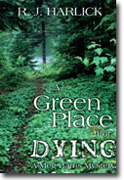
A Green Place for Dying - by RJ Harlick

 
Last night I opened ‘A Green Place for Dying’, the fifth Meg Harris novel by RJ Harlick, just released by Dundurn.

It's five a.m. and I’m still up.

This is one seductive book. It opened on a moonlit scene by still waters, with a group of mostly native women doing a renewal ritual. Before I knew it I was thigh-deep in soggy brush looking for a missing teenager. Then confronting an angry biker. Now someone else is missing, someone even more dear to Meg.

‘A Green Place for Dying’ is set along the Ontario/Quebec border, partly in bush and partly in Ottawa. The bush town of Somerset and the neighbouring Migiskan reserve are like the quaint, albeit murderous, village in the Louise Penny novels in that everyone knows everyone else’s business, or thinks they do. But here the village store sells venison pie and other wild-based foods instead of the designer dainties of Three Pines’ bakery, and the characters are more at home in jeans and deerskin jackets than in high-end sweaters. The story revolves around a touchy social issue: missing native women for whom the police don’t bother searching. There’s also a deeply unhappy local family with a black sheep brother and a missing daughter that Meg is helping to trace. An old secret in Meg’s past is rising to haunt her just when she needs to keep a clear head.

Not noir, and definitely not a cosy despite the lack of on-page violence, this novel is a traditional, suspenseful mystery in a non-traditional setting. The bush is an integral element, its sights, sounds, scents, and textures underpinning crucial scenes and drawing the reader deep inside the tensions and joys of the half-French, half-Native, half-English community with its crisscrossing lines of culture, language, and authority. 

You don’t need to have read the other books to really get this one; references to past events are understandable in their context. Highly recommended.

Sample the opening HERE