Search This Blog

Sunday, July 17, 2011

From Bronte to Bosworth

Kate Bosworth, that is. The lead actress in the surf movie "Blue Crush." Or more particularly her character, Anne Marie Chadwick, a Hawaiian girl from the wrong side of the island who lives to surf but pays the rent for herself and her little sister by working as a hotel maid and teaching tourists to surf.

Struggling for money was something with which the Bronte sisters were more than familiar. What, after all, were their life choices pre-1850 except servitude as governesses, deepening poverty if they stayed home as unmarried women, or marriage to any man likely to keep a roof over their heads and food on the table? Yet all three of the surviving Bronte sisters, Charlotte, Emily and Anne, escaped their cheerless existence by exercising their imaginations and their intelligence, writing novels and poetry. 
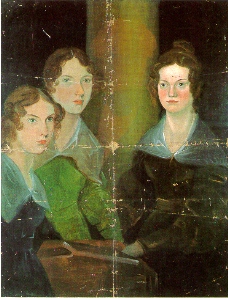


 From left to right: 
Anne, Emily, and Charlotte
 
This picture of the three Bronte sisters was painted by Branwell Bronte. He had painted himself into the picture, but painted himself out later. There is still an outline of his form in the pillar.


Occupying my thoughts today are the overlaps and divergences between Charlotte's novel and Emily's, and the persistence of their themes into the present day.

In 'Jane Eyre', Charlotte Bronte wrote of the life of a governess and schoolteacher. She wrote what she knew - a harsh girls' school and harsher religious teachings, followed by teaching and governess jobs - but added to Jane a spirit of independence and pride that the girl's upbringing, unlike Charlotte's, would not have fostered. Add in a yearning to travel, to see the world beyond the confines of either the school or the secluded manor at which she is governess, and you have the seeds of a modern young woman's dreams, albeit without much opportunity to fulfill them (except by a good marriage).

Emily Bronte wrote of a young woman more at home on the wild moors than in polite company, and endowed her with a fond father who let her run wild in ways that sheltered, slightly fragile Emily (with two older sisters already dead of illnesses in childhood) could never have pursued. Catherine Earnshaw wants nothing that is not available within a few miles around her home.

Emily and Charlotte's mother died young, leaving her surviving children with only the vaguest memories of her. Jane Eyre and Catherine Earnshaw lost their mothers at an early age.  Jane finds her way as Charlotte did, pouring out her intellect and spirit on other people's children. Emily's heroines have no such solace; they are bereft of mother-love almost at birth and brought up surrounded by men, much as Emily was, living at home with her father and brother while her more resilient sisters were out earning their bread.

The heroes - or perhaps the male leads is a better term, to avoid arguments over whether Edgar or Heathcliff is the more heroic in "Wuthering Heights" - are similar: masterful men capable of schooling their horses and their women, neither capable of seeing the world through anyone else's eyes. Where Mr. Rochester is softened by Jane, Heathcliff is hardened by Catherine. One is saved by love, the other damned by it.

Breaking no new scholarly ground here, the choices their heroines make 'for love' are a marked point of divergence. Jane Eyre falls in love with Mr. Rochester because he values her mind and her conversation. Although she leaves him rather than compromise her moral values, she comes back to him as his equal, not as a servant to be elevated by marriage. Catherine loves Heathcliff with a passion beyond reason, based on physical chemistry and certainly not for his intellectual attainments or his respect for hers. She marries Linton not for love but for lack of alternatives, and soon withers, leaving behind her own motherless daughter to the same narrow life in the same small space.

Divergent choices: Charlotte's heroine crying out  to be valued as a thinking individual and unwilling to settle for less than a full partnership in marriage, Emily's heroine caught up in passions too strong for her untutored rational side and coming to a tragic end that has enduring tragic consequences for the rest of her family.


(Might I insert here a plaint about the movies made of those novels? While the recent Masterpiece Theatre adaptation of Wuthering Heights makes better sense of the psychology of the characters than did the torrid 1970's version I first saw in a cinema, there is still not much effort to explore the social or cultural themes underpinning the novel. It is presented as a tragic love story with a faintly optimistic ending. All the Jane Eyre adaptations I've seen, and they have been many, have focused too exclusively on the relationship aspects, overlooking or minimizing the social conditions of Jane's - Charlotte's - upbringing/education and especially failing to explore her expressed desire for equality in life and love. She is presented always as a woman of her time and station, only slightly more outspoken than normal for those circumstances. When will we see a truly human Jane Eyre?)


And so down the century-and-a-bit to Anne Marie Chadwick, bikini-wearing surfer girl in "Blue Crush". 

What, you may well ask, links her to the Bronte sisters' heroines? 

Mothers dying in childbed, or being absent early in their children's lives from other causes, were not uncommon occurrences in the 1800's. That is not the case in today's England, with improved maternal health and health care generally. 

Nor in Hawaii, where Anne Marie and her younger sister are nonetheless motherless, their mother having gone off with some man to California with apparently no intention of returning to take up her parental responsibilities again. Anne Marie, having left school early, is working at a menial job to keep food on the table for her little sister, trying to keep her sister in school and out of trouble. 

Our surfer girl has a chance to carve out her own life if she overcomes her fears and manages to win a surfing competition that will lead to sponsorships, self-respect, and financial freedom. But a handsome man is offering her a vision of a life of ease. In modern movie romance, 'Mr. Rochester' is represented by a pro football player who hires our heroine to teach him to surf. He soon is buying her clothes and encouraging her to spend his money in the luxurious hotel suite she was employed to clean until a few days earlier. The other football players all have kept women with them, women whose clear goal is to lure as much money, jewelery and physical enhancements out of their companions as possible before moving on to another free-spending athlete. 

While this modern Rochester does not hint that he himself will take Anne Marie away from her life of drudgery and poverty at the end of his Hawaiian vacation, we would have to be living under rocks not to see that she could have an easy life if she abandoned her sister's upbringing and her surfing aspirations to cash in on the succession of rich athletes and other male guests at the resorts.  

Jane Eyre's moral test was whether to become Rochester's mistress instead of his wife, and Cathy's challenge is to change the life she inherited from her passionate but unwise mother. Anne Marie's great moral test is whether she will repeat her mother's life choice of running out on her family responsibility and, equally important, turn her back on her own goals in favour of an easy escape from her present poverty. Will she be a Catherine or a Jane?

The night before that surfing competition, she faces the truth of what she wants in her life: enough money to pay the bills, her mother to come home, her sister to grow up without any disasters, and to win the surfing competition for herself. The only one of those her Mr. Rochester can provide is money, and that, by the nature of their relationship, is a temporary fix. Winning the surfing competition will provide two out of the four and increase her sister's chances of breaking out of the family pattern in her turn. She leaves him and goes home to prepare for the competition.

As Jane Eyre is rewarded for her virtue and high principles by gaining not only an inherited fortune of her own but an equal love with Mr. Rochester at the end of the novel, so, at the end of the movie, do we see Anne Marie rewarded. She overcomes her own fears to give the best athletic performance of which she is capable, earning her a sponsorship and the promise of not only income but support for continued training. Her other reward, very like Jane's, is to be treated as an equal by her modern-day Rochester, as a fellow athlete with a career of her own rather than as the servant girl he can (however temporarily) lift from her poverty. 

As Jane Eyre ended on the happy note of her marriage to and children with the man she loved - the ultimate reward for women in Charlotte Bronte's time just as Catherine Earnshaw's fate was the ultimate punishment for women who dared to love both deeply and unwisely - so Anne Marie Chadwick's movie tale ends on the happy modern note of rising career promise, improved income potential, and a future that includes her Mr. Rochester as a boyfriend who will understand the demands of her career and support her efforts.

And this, at bottom, is why Jane Eyre is still being read, taught, and re-visioned in books and movies for young women more than 150 years after Charlotte Bronte wrote it. We women may have come a long way, baby, but we still struggle with the need to be independent, to find our own financial security and to balance our career advancement with our relationship needs.

What does Wuthering Heights tell the modern woman? That's a story for another day, and I'm not sure I can think of a movie that makes a parallel.

Monday, May 23, 2011

The Witch of Babylon - a thrilling ride for archaeology/art history buffs

You know you’re in good hands with an author when, half a page into the prologue, you are bewitched to the point you forget what century you’re in.  The return to the book’s current reality half a page later was a brutal but effective wrench; it assured my intense interest throughout the remaining 320 pages.

But enough about the writing.

‘The Witch of Babylon’ is at once a complex art-history mystery centered on biblical scholarship, a breath-stealing thriller set in the early months of the Iraq invasion, and an intellectual exploration of links between Mesopotamian myths and European alchemical processes. Not to mention the archaeological lore and torch-lit journeys into subterranean realms. Oh, and a personal journey of growth by a spoiled young art broker after the death of the older brother who has always shielded him from consequences.

This is a square-on hard stare at the murky world of antiquities looting and trading as well as a disturbing return to the early, chaotic weeks and months of the Iraq invasion. Add a soupcon of travelogue over the streets of New York City and various parts of the Middle East, and there is much to enjoy about this book.  For those who like extras (ie me) there's a map, a short historical note at the beginning and more historical information sections at the back for those who want to go deeper into the arcane subject matter.

My ARC was sent by the author, D.J. McIintosh (after my bugging her for three years to be allowed to read the full manuscript). When it arrived I read the whole book in a sprint, with only meal breaks, and will now read it again more slowly, to savour the unfolding story.

‘The Witch of Babylon’ was short-listed for a Debut Dagger in 2007 and won an Arthur Ellis award for Best Unpublished Crime Novel in 2008. It is being released by Penguin Canada in June 2011 and (at last count) has sold rights in 15 languages around the world.  
  
 ‘Witch’ is the first book of The Babylon Trilogy.  I can't wait for the next.   

D.J. McIntosh
ISBN 978-0-14-317572-8
Penguin Canada
June 2011

Those Who Fight Monsters: Tales of Paranormal Detectives

An anthology can be a tricky assemblage. A strong theme can result in stories of a similarity that wears on the reader, while a weak theme leaves disconnects from one story to the next, gaps that allow the reader's attention to leave the book entirely. Editor Justin Gustainis found a good balance with 'Those Who Fight Monsters.' All stories have a monster (or more than one) and a detective, yet each stands alone in respect to characters and plot.

The detectives cover the gamut from hard-boiled PI's giving - and getting - low blows on the mean streets to intellectuals expounding on crime in refined quiet rooms. Sleuths include the demon-fighting soccer mom trying to shepherd her daughter safely past demon-snares as well as the normal risks of adolescence, the disgruntled Security sorcerer who battles bureaucracy as well as beasts, and other detectives both amateur and professional.  

The paranormal elements are equally varied. In addition to the usual vampires and werewolves, there are demons of compelling variety and more than one style of shape-shifter. Snakes, ugh.  Fairy-tale creatures such as gnomes and fairies also appear. The detective isn't necessarily chasing a monster, nor is the monster always the villain. The settings are mostly urban, mostly modern, with an overlay (or underbelly) of fantasy elements. 

One reservation about this collection was that some authors presumed a familiarity with their series work and left me faintly lost at first, while others seemed to be trying to fit several novels' worth of back story into the opening paragraphs and slowed the pace accordingly.  Apart from that disparity, the collection was a joy to read and introduced me to several paranormal/mystery crossover authors I'd not heard of previously but will certainly follow up now. 

All in all, these fourteen stories provide plenty of meat for both the detective-story aficionado and those fascinated by paranormal fiction. And, if you've ever pondered the fictional detective as a reflection of archetypes, Gustainis' introductory essay is a treat.  


(This review was previously published on DorothyL and on www.mysterywritersink.blogspot.com)

Saturday, March 19, 2011

A Grandmother of the Limberlost


'A Girl of the Limberlost' by Gene Stratton-Porter was first published in 1909. My Scottish-Canadian grandmother, Grace, was awarded a copy at her one-room schoolhouse sometime in the following decade, a copy inscribed to her personally. It was not the only book awarded to her during her schooldays for 'First in Class', but this one, which she treasured and re-read throughout her life. was found in her personal trunk after she died at the age of 92. What could be a more ideal book for entering the world of my grandmother's reading?

Thanks to my local library, I've now finished reading a hardcover copy of this novel in 2011, 102 years after its publication. (Aside: I wonder if e-books published today will still be readable, not by humans, but by the technology available in 2111)

'Limberlost' is a sequel to 'Freckles', about which I knew nothing beyond the title. Project Gutenberg and Wikipedia inform me that the title character is an orphan who finds employment and his life's passion in the flora and fauna of the Limberlost Swamp.

Freckles is a grown man and moved away by the time 'A Girl of the Limberlost' opens, but has left his lore and his moth cages in the swamp for the use of Limberlost's heroine, Elnora.

The story of 'Limberlost' opens with Elnora starting high school at the town nearest her farm. She has largely brought herself up to this point while her widowed, embittered mother begrudged every mouthful of food and item of clothing. Her patience and sweetness have endeared her to the neighbours, and will do the same to everyone she goes on to meet in this new, wider world.

Scrambling over and around obstacles thrown up by her mother and an uncaring world, she turns her hard-won knowledge of the swamp's flora and fauna into enough money to pay her tuition and clothing at high school, and dreams of attending college. She has inherited from her dead father a keen sense of music and trains herself into a accomplished violinist. Eventually, beloved by everyone including her much-softened mother, she finds a True Love of her own and (after a few more obstacles thrown up by another mean-spirited woman) lives happily ever after.

Although she seems a bit too perfectly adorable and virtuous for my modern sensibilities, Elnora clearly made a strong impression on my grandmother. But what exactly this novel tells about my grandmother is not clear. Grace gave her only daughter the middle name of Eleanor, not Elnora, likely because - especially in the wake of anti-European sentiment following the first world war - her conservative farming family wasn't accepting of any name that sounded 'foreign'  (long story short: immigrants were exempted from The Conscription Act that lost many Canadian families their sons in the final year of WW1). Did Grace identify with Elnora's fascination with moths and butterflies? Her familiarity with daily farm chores that also took up much of young Grace's day? Her struggle to get dresses similar to those of the other girls at school, or to overcome unreasonable parental demands in order to carve out her own life and identity? A family legacy of bitter women visiting tribulations on their daughters? I don't know enough about Grace's early life to hazard a guess.

Maybe, on later readings, Grace identified more with Elnora's mother. Mrs. Comstock was deeply disappointed to learn the true character of the man she had married. On my few childhood visits to my grandparents' farm, I don't remember open hostility between them (although my mother assures me it was a constant feature of her childhood) but I also don't remember them speaking to each other beyond the most necessary words. Certainly there was no laughter or affection between them or from them to their children. In that sense, Grace had recreated the dynamic between Mrs. Comstock and Elnora. I wonder if she regretted that bitter relationship even while she felt helpless to change it. Maybe, in her last re-reading of 'Limberlost', she was clinging to the hope that, like Mrs. Comstock, she too would live to experience a reconciliation and renewal of mother-daughter affection.

Maybe I'm drawing too many inferences from too little evidence.

'Limberlost' is in essence a moral tale where behaving well is eventually rewarded, where admitting (if only to yourself) your faults and making such amends as you can is a good thing, where taking the high road instead of stooping to malicious or self-serving behaviors makes you a better person. I can't tell if Grace tried to carry those moral lessons forward in her adult life. If so, her efforts were not rewarded by a True Love and a happily-ever-after, unless you count the simple enjoyment of life she found after her husband died and she moved into a small house in town for her final decades. 'A Girl of the Limberlost' was one of the very few non-household possessions she took with her from the farm.

In the interests of further research, I read 'The Magic Garden' written by the same author near the end of her career and posthumously published. In this one, the heroine is again a lonely isolated girl who yearns for love. Her mother is as cold, rejecting, and neglectful as Elnora's mother, although as rich, vain, and attention seeking as the eventually-humbled Edith in 'Limberlost'. Our girl's father is not dead and eventually, through her (misguided) bravery comes to know and love his little girl. She makes every effort to grow up to be a worthy woman (exactly how is rather glossed over) and she, like Elnora, finds True Love and lives happily ever after. Was the author working out her own issues with all these mean-spirited women who neglected or emotionally abused their daughters? Or merely revisiting a literary trope proven to engage female readers and sell books?

One moral of this much shorter tale is that divorce can be very hard on the children involved. That particular marital resolution was likely not much seen in the author's social circle prior to the 1920's, and even less so in a tiny farming community in mid-northern Saskatchewan. I suspect my grandmother, if she ever did read this book - published after she was already a wife and mother isolated on a farm with an uncaring husband - might have thought longingly of those possibilities.

Wednesday, March 9, 2011

Reading my Grandmother - the Fairy Glen Library

When you start asking questions about your family history, all kinds of fascinating facts come forward. Such as…

There was a library in the tiny hamlet of Fairy Glen, though not when my grandmother was a girl. She had left home before it was established in my great-grandmother’s living room, around 1928. One of my uncles described it to me as shelves against the end wall, maybe 12 feet long by 8 feet high, crammed with fiction – mostly westerns – and non-fiction. The library even had a name: Aurora Borealis. 

(My library looks pretty much the same... more board feet of shelving... but all the books in it belong to us, and we just call it the 'living room')

The sign-out record at Aurora Borealis was a ledger with columns labeled by hand:  title/date/person taking/date returned. In a community of less than 200 people, that was sufficient. The librarian - even when she was not your own grandmother - knew not only you, but your mother, father, siblings, and extended family. She not only knew your phone number (if you had one) and your class at the only school, but she would likely see you at least once a week in company with your parents, teachers, friends, and other people who would frown alarmingly (if they did nothing worse) to find you had abused the privilege of using the library. 

My uncle made a few phone calls and traced the movements of the library: beginning at his grandmother's house around the time the railroad and grain elevators came to Fairy Glen, it moved to Mrs. Ronning, who also had the post office. After World War 2, Mrs. Ronning's boys came home to a dearth of local jobs and she moved away with them, sending the post office to a neighbour, Red Glover, and the library to the schoolhouse, which had been expanded well beyond its one room by then due to an influx of families forced off their farms during the Great Depression. Sad to say, when the Fairy Glen school was amalgamated into the Melfort school unit, the building and contents were essentially abandoned. After some incidents of vandalism, a former teacher rescued a few boxes of books, the last remnants of a pioneer initiative that encouraged reading and the acquisition of knowledge in that isolated farming community for several decades.

My first concrete link to my Scottish-Canadian grandmother’s reading habits has also turned up: my mother remembers that her mother was awarded a book while she attended that original one-room schoolhouse. She read it many times and kept it in her private trunk all her long, long life. The book was Gene Stratton Porter’s Girl of the Limberlost.

This book has been in print since 1909, and my local library (Alexander Calhoun Branch, Calgary Public Library) sent me over a copy within two days of my requesting it. I LOVE my local library!

My uncle remembers my grandmother had 4-5 girls books inscribed with ‘for First in Class’, and suggested I look for ‘Girls of the True Blue’. This book was one of around 300 written or co-written by L.T. Meade in the late 1800’s and early 1900’s (she died in 1914). 

Sadly, this particular title is not available either at my library or on Project Gutenberg. Doubly sad because, as an Irish-born author, L.T. Meade could well have been on my English grandmother’s childhood reading list as well.Gutenberg has numerous titles available, though, so until I get more specific information, I can taste-test the books and get the flavour of both my grandmothers' girlhood reading options.

This weekend, though, I will open 'A Girl of the Limberlost' and experience for the first time a book that I know was a vital part of my Fairy Glen grandmother’s reading life. One small connection is made.

Wednesday, March 2, 2011

Reading My Grandmothers - Library history

A smidge of library history for you:

The first library at Melfort, Saskatchewan to which my Scottish-Canadian grandmother would have had access was opened in 1928, by which time she was 24 years old, married, with two babies. Even if she hadn't had babies and farm work to contend with, Melfort was 26 km from Fairy Glen (where her school was), and even further from her farm.

Current Melfort librarian Penny Markland wrote me about that first library:

Rules about the use of the library were rather more stringent than they are today.  Members were to have no more than 1 book at a time for no longer than 2 weeks.  Those with overdue books were strictly dealt with, being expelled from library membership after the 3rd offense!   In 1932 the librarian’s salary was $120.00 per year.  $51.84 was spent on books that year.   I don’t think children were necessarily allowed in the library back then, although I’m not totally sure.
Isn't that last bit fascinating - and scary - when we consider how many children nowadays learn to love books and become lifetime readers because of free storytimes at the local library?

Not that the library looked like a particularly child-friendly place anyway. It was on the second floor of the post office, though, so at least it was centrally located for anyone who did get into town once a week from the surrounding countryside and villages.


This is the new library:

It has all the services we take for granted nowadays: not only books and magazines but computers with Internet access, storytimes, kids' crafts, book clubs, classes for all ages, general interest programs and specialty guest speakers.

The one thing that hasn't changed, I bet, is that the librarians still do their darnedest to encourage children to explore the boundless worlds between the covers of books.