
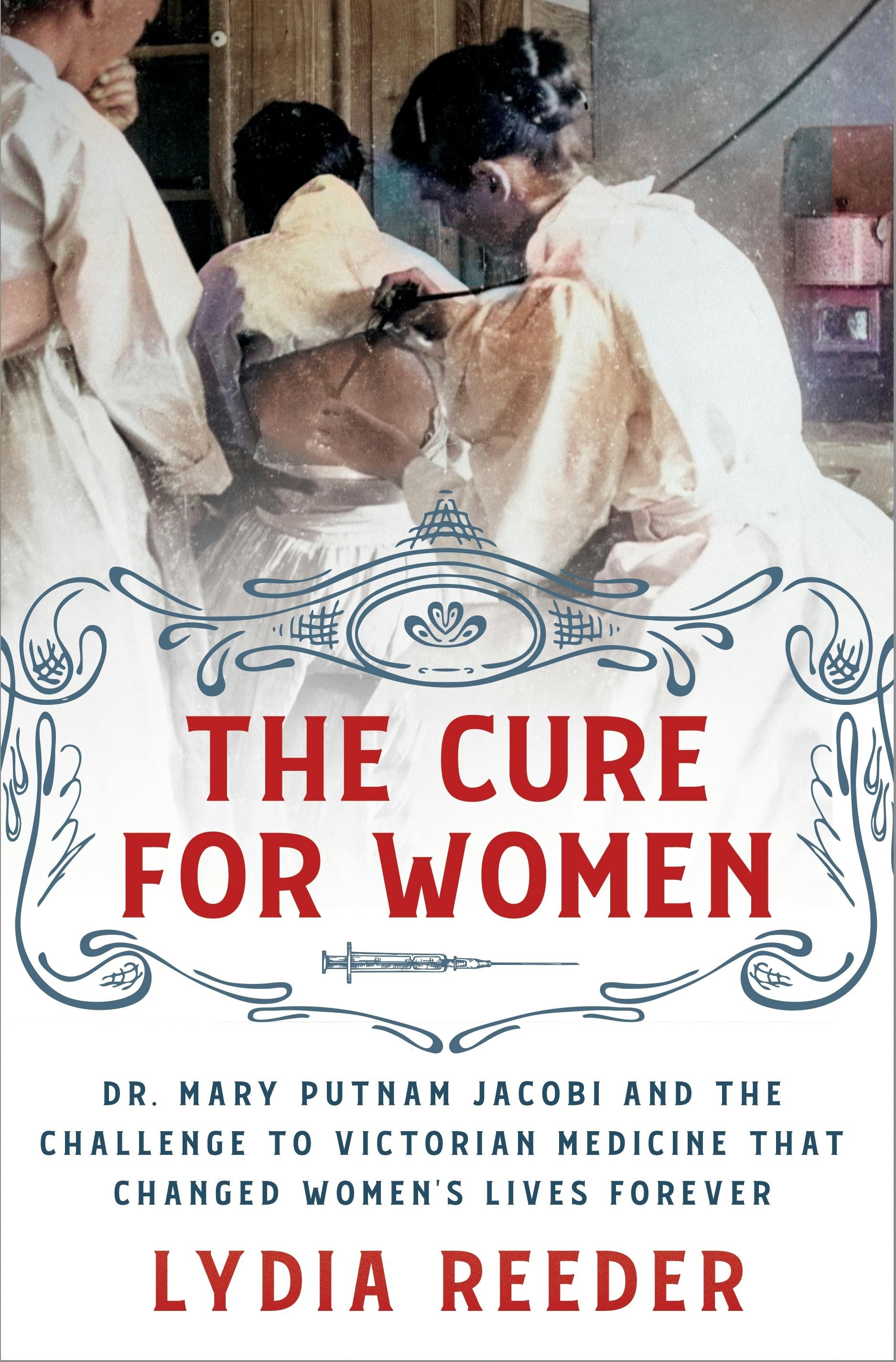
Dr. Mary Putnam Jacobi and the Challenge to Victorian Medicine that Changed Women’s Lives Forever
By Lydia Reeder
This book is both wonderfully and terribly timely in an era when under-informed male lawmakers and their supporters are once again trying to roll back women’s health care, especially around wombs and vaginas. Just as male dominated medical schools in the mid-1800s worked hard to remove woman as midwives from the birthing rooms, destroying centuries of traditional supportive care for pregnant and post-partum women, so a still-patriarchal medical system now is attempting to overturn much of the past 150 years of advances in medicine for women.
So many women fought to get us where we are now. Watching their labour, and all the work of other women since them, be overturned by ignorance and deliberate misinformation is both heartbreaking and enraging.
So who are those Victorian women who changed women's health care?
So who are those Victorian women who changed women's health care?
We learn about not only the Mary Jo Putney of the subtitle but also Harriet Hunt, who petitioned for the right to sit in on lectures at Harvard Medical School and organized the Ladies’ Physiological Society of Boston. Harriet later connected with early American suffragists Lucy Stone and Lucretia Mott, and helped make women’s medicine part of the national women's rights conversation. Harriet also joined with wealthy women in Ohio to start the Ohio Female Medical Loan Fund Association, that funded women medical students across the country via interest-free loans.
Elizabeth Blackwell, who was the first American woman accepted into regular medical school.
Sarah Hale, the influential editor of Godey’s Lady’s Book, the USA’s most popular women’s magazine in 1851, who ran a series of editorials praising female physicians as being ‘by nature’ more suited to take charge of the sick and suffering.
Ann Preston, the Quaker woman who was training in and organizing ‘irregular’ medical schools that taught about home and public hygiene , nutrition, and instruction on human physiology. She was also successful in enlisting Elizabeth Blackwell to help overcome Victorian women’s reluctance to give up their ‘purity’ over allowing doctors to physically examine them.
(Male doctors at that time generally examined women in the dark, by touch, with the patient fully clothed. Having access to female physicians permitted women to be examined and treated without fear of losing the respect and regard of their husbands, and was ultimately one of the chief social advances leading to a drop in women’s mortality rates in the latter half of the Victorian era.)
Marie Zakrzewska as a child spent a few months in a teaching hospital in Berlin, where her mother was training as a midwife. Marie took to following the doctor on his rounds and eventually he offered her books from his medical library to study. In adulthood she went back to the hospital to train in obstetrics and later emigrated with her younger sister to America, where she found that male doctors had succeeded in virtually barring women from practicing medicine. So she set up a knitting business instead. Eventually she connected with Elizabeth Blackwell through volunteer work at a homeless shelter and was invited to work with her. Marie was one of the early beneficiaries of the Ohio Fund to pay for her advanced medical training.
This is also a tale of men like J. Marion Sims, a surgeon and avid self-promoter who became very wealthy working on rich white women after he honed his techniques for gynecological surgeries on un-anesthetisd slaves and destitute women, often naked, in an auditorium full of men who found the weeping and screaming of the agonized women an added feature of the ‘show’. He started his first Womens Hospital by recruiting rich NY women to sit on a managing board, and then later incorporated it, removing all power from the women’s board and placing it in the hands of an all-male board of governors drawn from the richest magnates in the region, whose expertise lay not in medicine or womanhood but in making money. It’s not hard to see the entrenchment of the USA’s highly monetized health care system in moves like this.
Victorian women fought for decades to get the right to not only attend medical school but to treat patients and, maybe most important, to teach other women about caring for their own bodies. Now that is once again under threat, and it behooves all women to inform first themselves and then their sisterhood about the fight that got them the medical comprehension of women’s issues they have thus far benefited from in their lives.
Let us not throw out all those hard-won gains by all those generations of women (and their few male allies) who fought this fight before us.


