Search This Blog

Monday, November 11, 2013

War and Remembrance in Crime Fiction


From battlefield poetry like “In Flanders Fields” to modern blogs about war experiences, the written word is our most enduring way to climb into the experiences and effects of war. Non-fiction accounts begin even before the conflict ends, in battlefield reports and letters home, and military if not popular analyses are produced seemingly forever more. Literature in other forms goes in and out of fashion, and crime fiction takes its turn.

We all know of John McCrae, who wrote that most iconic Canadian poem still recited in schools and now sung at Remembrance services nearly a hundred years later. But how many remember the many other trench poets, from Canada and other nations, who recorded the brutal truth of war with words of power and beauty that, when widely read by the non-combatant public far from the Western Front, helped force an end to firing squads as the punishment for shell shock, and may have hastened the end of the war?

Their leaders were unquestionably Siegfried Sassoon and Wilfred Owen. The latter was killed before he could see what change his words had wrought in his society, but his work is taught in first-year English classes every fall across this country and continues, nearly a hundred years after his death, to influence discussions of war and human conflict.

In longer works, there are many general novels that touch on the war in some aspects. One in particular shows the changing public attitude to war. Lucy Maud Montgomery wrote the last of her ‘Anne of Green Gables’ books during and immediately after WW1, about Anne’s children growing to adulthood during those years of patriotism, gritty reality, and overwhelming losses. Rilla of Ingleside was published in full in 1921 and considered a realist account by those who had lived through the war years in Eastern Canada. 

When it was republished a few decades later, five percent of the book - mostly dealing with the first world war as it was experienced in rural PEI families- was edited out to make it more suitable for a new generation of young female readers, who were assumed not to be interested. Fifty years later, fashion having changed again, Rilla was republished in its original form, and helped a new generation, mostly of young girls, see those parts of Canada’s history as more than bare words on the pages of a history textbook.

Literature, including popular fiction, helps both those connected to war and those removed from it to understand and process its pain. It breathes life onto the pages of history.  Crime writers who have integrated wars and their effects include

Dorothy L. Sayers gave her sleuth, Lord Peter Wimsey,  a recognizable and compelling case of what we now call Post-Combat Stress Disorder, but during and after World War One was known as shell shock. 

Helen McInnes, whose post-war thrillers included hunts for Nazi-looted treasures, and even for Nazis, had a closer connection to World War 2. Her third novel, Assignment in Brittany (1942), was required reading for Allied intelligence agents who were being sent to work with the French resistance.

Enid Blyton, whose Adventure children stumbled into a cache of religious and cultural treasures in The Valley of Adventure, introduced generations of children to Nazi art looting and the lingering effects of that war in Europe.


Andrew Martin, whose Jim Stringer novel, The Somme Station, takes us into the heart of a WW1 battlefield.

James R. Benn, whose Billy Boyle is a brash young Boston cop brought to Europe by his uncle Ike (yes, that Ike) to be a special investigator in theatres of war, looking into crimes too sensitive for local police forces, introduces mystery readers around the world to the command and complications of the American Army in WW2.
Mary Jane Maffini's Camilla McPhee novel TheDead Don’t Get Out Much is at once a lively chase and a heart-tugging tale of an older friend’s hidden WW2 history.

Carola Dunn's 1920s sleuth, Daisy Dalrymple, traces a connection between the Great War and the bodies found in a shallow grave in Epping Forest, in  Anthem for Doomed Youth, whose title is taken from the famous poem by Wilfred Owen, the World War One trench poet.

These are only a few of the many crime novels of the past century that deal with some aspect of some war. Every one brings war and its effects to life for readers of every age and interest level. While none of those listed here deal with the ongoing Iraq or Afghanistan wars, or other current conflicts around the globe, I'm sure they're out there. You'll find them if you look.


Crosses photo credit to Neil Zeller Photography, Calgary

Sunday, November 3, 2013

Good News for Daphne DuMaurier fans

 A new BBC adaptation of Daphne DuMaurier's "Jamaica Inn" is being made. The author must be floating in her grave with relief; by all accounts, she really disliked the comic version made by Alfred Hitchcock. 

New BBC adaptation of Jamaica Inn is filiming.


Edited in October 2016 to add that I've finally seen the adaptation and it's quite good, fairly faithful to the book's tone and the characters' psychological struggles. However, it was filmed far from Cornwall and to me the scenery just didn't have the same impact. Maybe I spent too much time in Cornwall, wandering in Daphne's writerly footsteps.

Sunday, August 11, 2013

Cornwall Spells Adventure Part Three


Part Three: Writing as well as reading

A confession: I too succumbed to the lure of Cornwall and its adventurous past – both fictional and literal – when searching for a setting for a tale I was writing for my daughter during university. The village of Polzeath, the hill known as Brea, the church of St. Enodoc that was (by the early 1800s) almost completed swallowed by a sand dune (and was already beginning to be rehabilitated to its current state below):
.....and especially the infamous, ship-wrecking sandbar known as the Doom Bar, comprised the locale for an adventurous tale involving smugglers, storms, and a dashing French spy. Where could my inspiration have come from?

That early novel of mine, written for the mutual entertainment of my daughter and myself, cannot compare in evocative settings nor absorbing characters to the Cornish house, residents and visitors in Mary Wesley's The Camomile Lawn. 

Filmed largely at Veryan, Cornwall in and around Broom Parc House (now a B&B), this novel followed five young people through the perils of reaching adulthood during WW2, and into their later adulthood. A mini-series made from this novel in 1992 follows the novel closely, and features, amid a strong ensemble cast, mother-daughter actors Rosemary Harris and Jennifer Ehle playing the older and the younger incarnations of the character Calypso.

Other notable writers claimed by Cornwall include William Golding, perhaps best known in Canada for Lord of the Flies, and Rosamunde Pilcher, whose many novels of family and relationships include The Shell Seekers, whose two movie adaptations were filmed largely in Cornwall where the book was set.
 
Cornwall is a land of many stories, and almost as many novelists.And yet, for all the years and novels that have passed my way, when I stood on a headland this summer with the wind whipping my hair and the seabirds calling with their many voices, I shaded my eyes against the sun and peered out through the sea-haze, looking for a rocky isle topped by a building that might be either a ruined castle or a crumbling engine-house. At that moment, I could not help but wonder if by chance Enid Blyton stood here one day decades ago and said, “I will call that island Gloom, and send four children and a parrot there on an adventure,” or “I will name that rock Kirrin Island, and send four children and a dog there on an adventure.” It's not likely either, but in my imagination one of those calling gulls may not be a seabird at all, but Kiki the parrot mocking them, and calling me to adventure.

I am not alone in this mental wanderring. Cornish settings were used in several tv adaptations of this author’s novels, as recently as the late 1990’s. Such is the power of stories read in childhood.

For me, Cornwall is and forever shall be a place where Adventure is around every corner.

Thursday, August 8, 2013

Cornwall Spells Adventure Part Two


Part Two: Smugglers and Wreckers


However it came about, my fascination with Cornwall endured, and I confess to a visceral thrill when, soon after crossing the Tamar into Cornwall, I saw the sign from the motorway: Jamaica Inn.


Yes, the Jamaica Inn of Daphne DuMaurier’s novel still stands, much as it has done for more than 300 years, frowned over by the higher tors, its gray stone face frowning in turn down on the rock walls and green fields below.


Now the building is a combined hotel, pub and smuggling museum, in which Daphne Du Maurier and her novels have pride of place.  A tour bus was leaving as we arrived, another arrived as we departed, but the querulous voices of visitors could not drag me from my fictive dreams any more than a train thundering by could wake Dick Young from his in The House on the Strand.

Mary Yellan walked those fields in Du Maurier’s imagination and in mine, to escape the oppressive atmosphere of the inn below and the ever-imminent violence that brooded inside its landlord. 


The bar is rich in aged wood and it’s easy to imagine gangs of smugglers, wreckers, ruins that once were men, plotting their villainy over their pints.


There are two movie versions of the novel, Jamaica Inn: one from 1939 (only three years after the book was published) stars Charles Laughton and Maureen O’Hara in a typical Hollywood adaptation that wipes much nuance from the novel along with several key characters, and the other a 1983 tv movie starring a very young Jane Seymour, which is a bit closer to the novel and, being in colour, effectively utilizes the dramatic scenery of Cornwall.


Indeed, it is impossible for a dedicated reader of DuMaurier to traverse Cornwall without seeing signs of her books everywhere. 

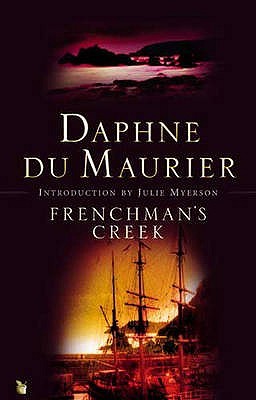
As we traveled away from Jamaica Inn, circling toward the northern coast, there was a sign for Saint Colomb, and instantly I was with Dona of that name as she scrambled down a woodland path toward Frenchman’s Creek. King Charles has fled England
before the advancing Dutch armies of his daughter and her husband, leaving Catholics like Dona and her children in danger from emboldened Protestant lords and their soldiers. Dona falls hard for a Frenchman, formerly a pirate and now a French patriot, who hides his ship in the creek of the novel's title. 

Seeing that sign brought it all back to me: the fraught political situation that chased Dona from London, the spies creeping around her manor house by night, her children's peril, her torn loyalties. That is the power of a master of the craft of fiction, to bring all that back a decade or more after my last reading of the novel.

That is the magic of Cornwall, to inspire masters of their craft to bring the place, the people, the essence of that land to readers all over the world. Would that I, one day, could bring some essence of my land to readers far away, that they, when they come at last to my forests and foothills, will remember half as much of my work.

Monday, August 5, 2013

Cornwall Spells Adventure

Part One: Getting there is half the fun


Rocky tors, windswept moors, a restless sea ever coiling around the knees of granite cliffs… This is Cornwall of yesteryear, and of today too, barring the odd motorway and a plethora of holiday villas. 

Instead of mine-shaft engine houses belching steam and smoke, now wind turbines march across the spine of the Peninsula, as alien to 21st-century residents as were the engine-houses to those in the 17th century. 
Even so, I love Cornwall, and loved it long before I was ever so privileged as to visit.


The Cornwall of my imaginings is peopled not by IT professionals and taxi drivers, exhausted moms with over-stimulated tots and bored teens in tow. Instead, characters from books ride those narrow, stone-fenced byways and stride across the trackless moors. Smugglers, wreckers, wayfarers of good or ill intent all traverse the lands.

What books hooked me on Cornwall? Impossible now to say. Was it in 4th Grade, when Enid Blyton’s first “Adventure” book sent Jack and Lucy-Ann, Phillip and Dinah, into a long-abandoned copper mine off an iron-bound coast? Unlikely, as Ms. Blyton was careful to avoid labeling the real-life locations that inspired her fictional settings and, indeed, is claimed by Dorset if by anywhere.
Was it, then, when I as a teen followed Daphne DuMaurier’s Dick Young as he stumbled across the moor near Kilmarth in search of his (and my) 14th century fictive dream? Much more possible. 
DuMaurier loved Cornwall, set many of her books and short stories there, and lived long there in a semi-hermetical seclusion that can only be envied by authors forced to flog themselves in the screaming marketplace of today.

However my fascination with Cornwall came about, the moment of crossing the Tamar from Devon last month was a homecoming in a literary, if not literal, sense.


Wednesday, July 10, 2013

Review: "When the Saints Go Marching In" by Anthony Bidulka


 This is the first in a new series by award-wining author Anthony Bidulka, who made his name in mystery by writing about a gay detective living a big life in a small Canadian city. 

Adam Saint’s first outing has an explosive opening: a Russian plane crashes, killing the Canadian governor-general. The action jumps back to Canada, where a young mother is on the run with her son, running low on cash and hope. Weaving these two stories together is Adam Saint, a field investigator for a mysterious Canadian agency with international tentacles. 

The plane crash investigation flips from routine to deadly in the blink of his jet-lagged eye. From then on Adam stretches all his skills and stamina to stay ahead of pursuit that ranges from the heights of Asian luxury hotels to the bare Saskatchewan prairie. Can he discover who betrayed whom, and why, before time runs out for himself and for the innocents he has staked his life on protecting?


When the Saints Go Marching In is a high-stakes international thriller with down-on-the-farm community spirit.


Tuesday, July 9, 2013

Review: The Whisper of Legends by Barbara Fradkin


 This ninth book of the series drags Inspector Green far outside his comfort zone. 

When his daughter Hannah hits the whitewater on the breathtakingly beautiful and dangerously isolated Nahanni River, vague parental worries soon solidify into well-founded concern, for Green if not for the wilderness area’s more trekker-hardened RCMP.


 Disturbing facts come to light about the expedition’s leader. A freak storm washes one of the group’s canoes downstream. Mining consortiums war with environmentalists. Soon Green and Sullivan are on their way to the Yukon, hoping to find Hannah before the rising tensions rend her group and leave her stranded in a trackless, perilous wilderness. Desk-bound Green forces himself past physical and psychological weaknesses in an unfamiliar and hostile environment, where grizzlies and wolves are no longer the most dangerous predators.


Part family saga, part a thoughtful exploration of the growing conflict between environmental and resource-extraction priorities, “Whisper of Legends” is an adrenaline-fueled adventure, nearly impossible to put down.


The Whisper of Legends
Dundurn 2013